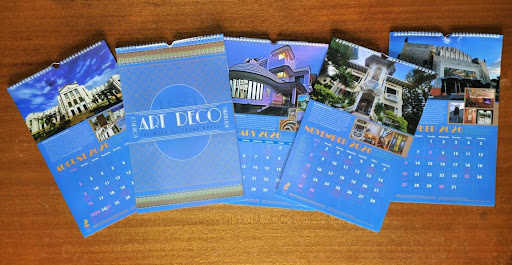
Bravofilipino | NCCA Marks 100 Years of Art Deco in the Philippines with 2026 Heritage Calendar | The National Commission for Culture and the Arts (NCCA) has unveiled its 2026 calendar, continuing its annual tradition of spotlighting Philippine cultural heritage. This year’s edition commemorates the centennial of Art Deco in the Philippines, aligning with the global observance of 100 years of the influential architectural style and underscoring its lasting imprint on the country’s urban and cultural landscapes.
Entitled “A Century of Art Deco in the Philippines,” the 2026 NCCA Calendar highlights 12 significant Art Deco structures, one for each month, located across the archipelago. The featured buildings illustrate how Art Deco shaped civic architecture, educational institutions, residential homes, and cultural landmarks throughout the 20th century, reflecting the nation’s evolving vision of modernity.
The project was conceptualized and designed by journalist, filmmaker, and cultural researcher Roel Hoang Manipon, who also authored the accompanying texts and captured many of the photographs included in the calendar. Additional photographs were contributed by Mervin Concepcion Vergara, Gerard Rey Lico, Ben Scharlin, Bien Alvarez, Lorraine Sy-Lianteng, Iya Cabrera, and Roezielle Joy Iglesia, providing a rich visual documentation of the featured heritage sites.
In his introductory essay, Manipon places Philippine Art Deco within both global and local contexts, emphasizing its historical and cultural significance. “As it marks its hundredth year, Art Deco in the Philippines deserves recognition not only for its beauty but also for its role in shaping the country’s vision of modernity,” he writes.
The calendar opens with the Generoso M. Villanueva House, popularly known as Daku Balay, in Bacolod City, Negros Occidental, followed by the First United Building in Binondo, Manila—one of the earliest Art Deco office buildings in the country. Other highlighted landmarks include the Rizal Memorial Coliseum in Malate; the University of Santo Tomas Central Seminary Building in Sampaloc; and the Bulacan Provincial Capitol Building in Malolos City.
Also featured are the iconic Far Eastern University buildings in Sampaloc; Molo Mansion in Iloilo City; the Quezon Provincial Capitol Building in Lucena City; the Old Municipal Hall of Jaro in Iloilo City; the Old Tanauan Municipal Hall, now home to the Museo ng Tanauan in Batangas; and the Gala-Rodriguez House in Sariaya, Quezon. The calendar concludes with the Metropolitan Theater in Ermita, Manila—one of the Philippines’ most celebrated Art Deco landmarks—which marks its 95th anniversary in 2026.
More than a functional datekeeper, the 2026 NCCA Calendar serves as an accessible cultural resource, inviting Filipinos to rediscover the architectural legacy of Art Deco and its role in shaping the nation’s built environment and aspirations for progress.